Paths Toward Utopia by Cindy Milstein & Josh Macphee
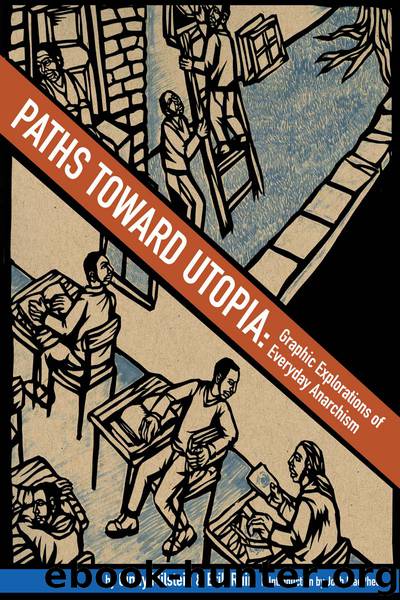
Author:Cindy Milstein & Josh Macphee [Milstein, Cindy & Macphee, Josh]
Language: eng
Format: epub
Publisher: PM Press
Published: 2012-10-27T04:00:00+00:00
NOTES
1. Martin Buber, Paths in Utopia (1944; repr., Syracuse, NY: Syracuse University Press, 1996), 14.
2. Ibid., foreword.
3. Theodor W. Adorno, “Cultural Criticism and Society” (1949), in Prisms (Cambridge, MA: MIT Press, 1981), 34.
4. Buber, Paths in Utopia, foreword, 8, 15.
5. Guy Debord, Society of the Spectacle (1967; repr., Detroit: Black & Red, 1983), para. 50.
6. Buber, Paths in Utopia, 2.
7. Which in turn, through the opening created by occupy but also in the necessary criticisms of it, has exponentially amplified calls for as well as grassroots organizing efforts to unoccupy and de-occupy many places.
8. The Invisible Committee, The Coming Insurrection (Los Angeles: Semiotext[e], 2009), 97.
9. By way of illustrating just how surprising this moment is—and how excruciating it feels to put any thoughts on it to paper—since I penned this prologue over two months ago, a student strike in Quebec and especially Montreal has grown into a maple spring of grand proportions. And this week, as it celebrated its hundred-day anniversary on May 22 and thirty days of nightly street demonstrations, this already-enormous movement has escalated into a widespread social strike, or maple summer—just to point to one of the many current twists and turns.
10. John Holloway, Crack Capitalism (London: Pluto Press, 2010), 29–30.
11. Buber, Paths in Utopia, 15.
12. Holloway, Crack Capitalism, 39.
13. For a sense of the occupy commons and the life it generated, see my “Occupation in Philly, Day 20 (October 25): Commons Not Capitalism,” Outside the Circle blog, http://cbmilstein.wordpress.com/2011/10/26/occupation-in-philly-day-19-october-24/ (accessed March 9, 2012). Martin Luther King Jr. (“Nonviolence: The Only Road to Freedom,” Ebony, October 1966, 30) popularized the notion of a beloved community with his often-cited observation, “Our goal is to create a beloved community and this will require a qualitative change in our souls as well as a quantitative change in our lives.” In his book Growing a Beloved Community (Boston: Skinner House Books, 2004, xiii), Tom Owen-Towle contends that in the early 1900s, U.S. philosopher Josiah Royce first used the phrase in print, and it was picked up in visions such as that of Clarence Skinner, a Universalist minister, who argued that to create a beloved community on earth, we must embark on “the task of inventing and applying arts which shall win all over to unity, and which shall overcome their original hatefulness by the gracious love, not of mere individuality, but of communities.” For bell hooks (“A Revolution of Values: The Promise of Multi-Cultural Change,” Journal of the Midwest Modern Language Association 26, no. 1 [1993]: 10), a beloved community also necessitates that “we must stand for justice, have recognition for difference without attaching difference to privilege.”
14. I’m aware that the word crazy can feel like, or even be, an insult in relation to mental health/wellness, and how the pharmaceutical-industrial complex’s medical model in particular and society at large in general both stigmatize those it categorizes as mentally ill. Here I’m harkening to the Icarus Project: “We recognize that we all live in a crazy world, and believe that sensitivities, visions, and
Download
This site does not store any files on its server. We only index and link to content provided by other sites. Please contact the content providers to delete copyright contents if any and email us, we'll remove relevant links or contents immediately.
| Anarchism | Communism & Socialism |
| Conservatism & Liberalism | Democracy |
| Fascism | Libertarianism |
| Nationalism | Radicalism |
| Utopian |
The Secret History by Donna Tartt(19037)
The Social Justice Warrior Handbook by Lisa De Pasquale(12183)
Thirteen Reasons Why by Jay Asher(8887)
This Is How You Lose Her by Junot Diaz(6873)
Weapons of Math Destruction by Cathy O'Neil(6261)
Zero to One by Peter Thiel(5784)
Beartown by Fredrik Backman(5734)
The Myth of the Strong Leader by Archie Brown(5495)
The Fire Next Time by James Baldwin(5429)
How Democracies Die by Steven Levitsky & Daniel Ziblatt(5211)
Promise Me, Dad by Joe Biden(5141)
Stone's Rules by Roger Stone(5080)
A Higher Loyalty: Truth, Lies, and Leadership by James Comey(4947)
100 Deadly Skills by Clint Emerson(4917)
Rise and Kill First by Ronen Bergman(4776)
Secrecy World by Jake Bernstein(4739)
The David Icke Guide to the Global Conspiracy (and how to end it) by David Icke(4699)
The Farm by Tom Rob Smith(4501)
The Doomsday Machine by Daniel Ellsberg(4483)
